

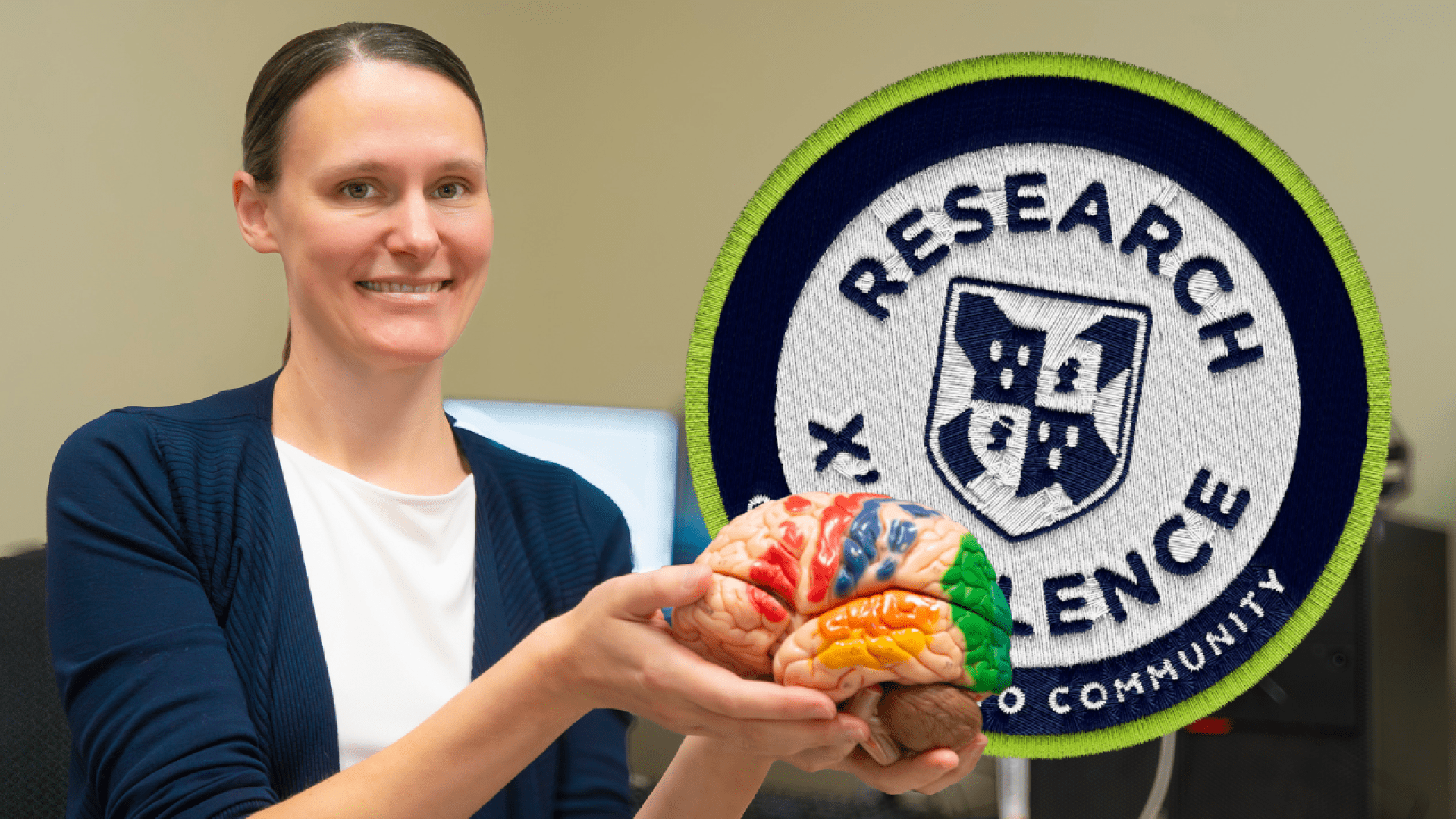
Research X’cellence: Our StFX community levering expertise on today’s most pressing challenges. At StFX, innovative research and creative activity are benefiting our communities, addressing some of today’s most pressing challenges. Research X’cellence shines a spotlight on members of our inspiring educational community and the impact they’re making. (To see the full series, please click HERE.)
Brain health: Dr. Erin Mazerolle developing new technologies, investigating ‘super agers,’ and maintaining your brain
When it comes to matters of the brain, Dr. Erin Mazerolle has much on her mind—and it’s all to do with promoting health and cognitive function.
With a background in MRI research, the StFX psychology professor is now working to create a more accessible, relatively low cost tool to diagnose brain health issues, a tool that could have major impacts on rural health.
Additionally, she’s focused on helping people maintain lifelong brain health, and is investigating characteristics of ‘super agers,’ those older adults with tremendous memories.
And? She wants to put more helmets on those riding bicycles.
MORE BRAIN IMAGING TECHNOLOGY
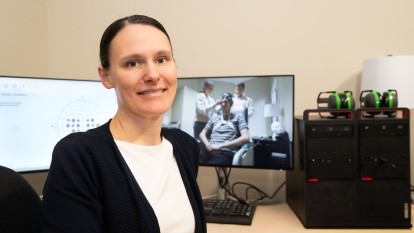
“I hope to make an impact by bringing more brain imaging technologies to a rural context,” says Dr. Mazerolle who joined the StFX faculty in 2020 and teaches courses on the brain and behaviour and advanced research methods for psychology.
Almost all brain imaging research takes place at large urban centres, she says, which excludes a lot of people. That’s one reason she’s working to adapt a new tool that is cheaper and more accessible to diagnose brain health issues.
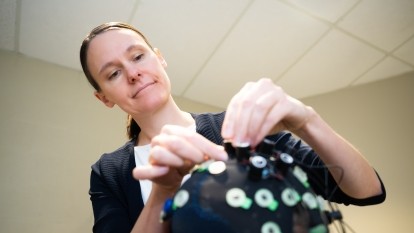
“It’s called Functional Near Infrared Spectroscopy (fNIRS) and it’s tracking brain blood flow using optical sensors,” she explains.
fNIRS is a non-invasive brain imaging tool that is portable, relatively low cost, and much easier to use than traditional imaging methods. Because of these advantages, it has strong potential to be used in clinical settings to assess conditions such as concussion, dementia and cognitive impairment, migraine, and stroke. The portable technology also has potential to be taken into people’s homes, giving them access to the resource they need and helping reduce wait times for diagnostic imaging such as MRI.
Dr. Mazerolle received Canada Foundation for Innovation (CFI) funding in 2022 to buy the equipment. She also developed a homegrown Cerebrovascular Reactivity (CVR) tool, built with help from the University Electronic Shop and the University Machine Shop. Funding from Research Nova Scotia for a five-year project to test this technology came in 2024.
Working with fourth year health student Kate LeBlanc, they’ve been evaluating the tool, testing how reliably fNIRS can measure brain responses across repeated sessions with about 50 young, healthy participants. Tests are repeated weekly to see if results remain consistent.
“The very first step is ‘do we get the same response from a healthy person week after week,’” she says.
Dr. Mazerolle says they hope to finalize data collection by summer 2026. “We don’t want to skip any steps,” she says. “Patient time is really valuable. Before we test it on a patient, we want it to be as meaningful and useful as possible.”
The next step after this will study sports related concussions. For this, Dr. Mazerolle will collaborate with human kinetics faculty member Dr. Sebastian Harenberg and hopes to expand existing partnerships with StFX Athletic Therapy and student athletes. Dr. Mazerolle will test athletes at the beginning of the season. If an athlete sustains a concussion, they will test once again as soon as that athlete is safely cleared, and then again one year later. “We want to see if we can track changes in their brain health.”
If able to track concussion-related brain health changes, she’d like to scale the research up with larger samples and different populations, including with people who suffer from migraines or who’ve had a stroke.
LAY THE FOUNDATION
Developing partnerships as to how this technology would fit into the health care system would be the final step.
“It’s still early days,” Dr. Mazerolle cautions, “we have a way to go before it could make a difference…but this foundational work is necessary to get there.”
Dr. Mazerolle was first introduced to neuroscience research as an undergraduate student. “It ended up totally consuming me,” she says.
“I really enjoy that everyone has a story about the brain and can connect to the brain. It helps me see how relevant the work we do is.
“We’ve learned so much about the brain in the last few decades, but there is so much more we don’t understand.”
BRAIN HEALTH LITEARCY
In her research work, funded through a Canadian Institutes for Health Research Planning and Dissemination Grant and a Vascular Training Platform Outreach Grant, she is also focused on brain health literacy and promoting strategies everyone can use to maintain cognitive function.
“There’s a lot you can do to protect your brain and keep healthy through the lifespan,” Dr. Mazerolle says.
“A lot of people think there’s nothing you can do, but actually there are things you can do.”
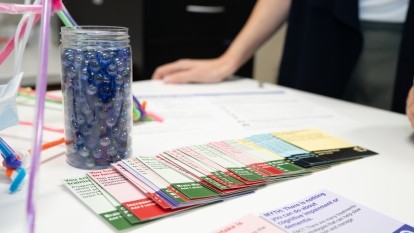
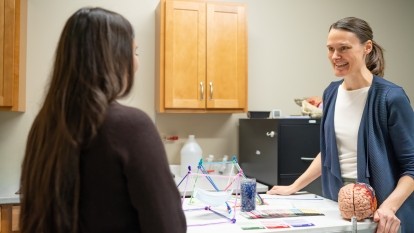
Working with honours psychology student Lydia Shaw-Peters and collaborators Dr. Megan MacGillivray (Health) and Dr. Lindsay Berrigan (Psychology), they’ve developed the ‘Maintain your Brain’ game, which is intended to share evidence-backed strategies to help individuals and communities maintain brain health throughout the lifespan. Ms. Shaw-Peter is evaluating a version of the game for adolescent audiences – an important audience as many don’t realize things they do as a young adult may impact brain health later in life.
They’ve co-developed the game with people with lived and living experience of cognitive impairment, Indigenous and South Asian educators, and alongside members of the healthcare and academic sector. They’ve held piloted events with X-Chem Outreach science camps, Knowledge Seekers Summer Scholars, and Mayfest Antigonish; and have built partnerships with local teachers who will help co-develop the game for adolescents.
SUPER AGERS, AND BIKE HELMETS
Through a Canadian Institutes of Health Research (CIHR) Catalyst Grant, Dr. Mazerolle (with Dr. Berrigan and Dr. MacGillivray) is also investigating what makes a ‘super ager,’ those older adults who have unusually good memory. Currently, there isn’t a lot of demographic and characteristic information available on who these people are, including variables such as lifestyle factors or prevalence in Canada. She’s looking to shed more light in this area.
Meanwhile, another issue she’s hoping to tackle is getting kids and other riders to wear helmets while biking. She’s actively looking for opportunities to provide helmets and knowledge to people to change this culture.
“I’d love to get more cyclists wearing helmets, especially children,” she says, noting how concussions and brain injuries can increase the risk of brain issues and dementia in later life.
In outreach activities, she has established the Antigonish Brain Bee, now in its fourth year. The Brain Bee, hosted by StFX, is a competition for high school students who are tested on knowledge about the brain and neuroscience research. It is designed to stimulate interest and excitement about brain research.
Dr. Mazerolle says this outreach is particularly important to help improve diversity among future scientists, getting more young people interested in brain research, and bringing more unique voices in the field.
At StFX, she is also a co-founder of the Used Laptops for StFX Students Program (with Dr. Laura Estill and librarian Kaitlin Fuller), designed to help reduce technology barriers for students. The program is a collaboration between the StFX Students’ Union and IT Services and sells used laptops to StFX students at a greatly reduced cost. The price covers the program cost and does not generate any profit.